





Xbox Repair in The Fix in Walmart Frederick
Is your Xbox giving you trouble? At The Fix in Frederick, MD, we provide quick and reliable Xbox repairs. From HDMI port damage to overheating consoles, our technicians offer free diagnostics and use high-quality parts to get you back in the game fast.
Professional Xbox Repair Services
- HDMI Port Repair & Replacement
- Overheating & Fan Repair
- Controller & Stick Drift Repair
- Disc Drive Repair
- Power Supply Repair
- Software Troubleshooting & Updates
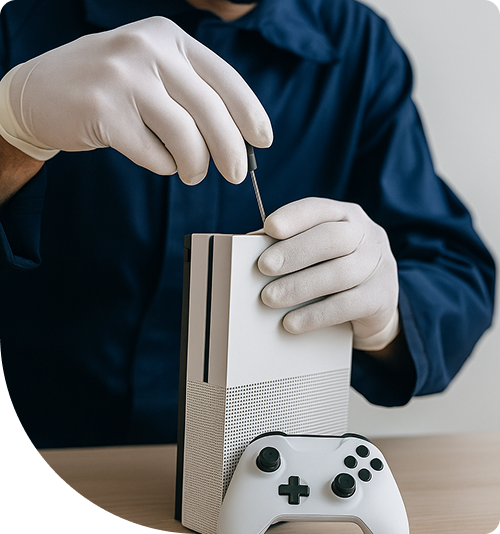
Professional Xbox Repair Services In The Fix in Walmart Frederick
Xbox Repair in Frederick, MD: Why the First Symptom Matters
Xbox Series X failures in Frederick develop through specific environmental stress patterns shaped by mid-Atlantic humidity, thunderstorm electrical transients, and thermal cycling. The APU heatsink thermal interface compound drying, GPU VRAM thermal pad compression gaps, HDMI solder fatigue, and NVMe storage expansion card oxidation all represent failures where early symptoms provide critical diagnostic windows. When an Xbox exhibits one specific symptom—graphical artifacts, intermittent video signal loss, or thermal shutdown—the technical root cause often progresses toward cascading failures if unaddressed. Understanding failure progression patterns guides intervention timing and prevents cascade to secondary failures that would transform a targeted repair into a complete system replacement.
First symptoms in Xbox failures signal specific failure progression chains. Addressing early symptoms prevents cascade to secondary failures affecting multiple subsystems. When you recognize early indicators of Xbox repair in Frederick, MD graphical degradation, video transmission issues, or thermal management failures, connecting with diagnostic professionals who understand Xbox-specific failure progression can prevent minor issues from developing into major repairs.
The Damage Clock
Xbox Series X APU heatsink thermal interface compound drying represents the most fundamental thermal management failure in the console. The APU—CPU and GPU integrated on a single die—generates substantial heat during gameplay. The thermal interface compound bonds the APU die to the copper heatspreader that conducts heat away from the processor. This compound degrades over years of thermal cycling. Frederick's Blue Ridge Mountains proximity creates dramatic temperature swings from winter cold to summer heat, with the Monocacy River valley amplifying humidity stress. The compound's silicone matrix dries out, losing viscosity and becoming increasingly rigid. The mechanical pressure required to bond the APU to the heatspreader remains constant, but the dried compound no longer makes intimate contact across the die surface. Microscopic air gaps develop at compound-to-heatspreader interface. Thermal resistance across the interface increases sharply. Heat transfer rate from APU to heatspreader plummets. APU temperature rises despite adequate heatsink cooling capacity. Within weeks of degradation, the APU reaches thermal throttle thresholds. Firmware detects excessive temperature and reduces processor frequency, limiting performance to prevent thermal damage. Games that previously ran at full resolution and frame rate now stutter and throttle. Users perceive this as hardware aging when in fact the APU itself remains fully capable—only the thermal compound requires replacement. GPU VRAM thermal pad compression gap develops from mechanical stress and vibration over the console's operating life. The GPU VRAM (Video RAM) chips dissipate heat during gameplay when rendering high-resolution textures and complex shaders. Thermal pads bond the VRAM chips to a heatsink that conducts heat away from the memory.
Thermal pads rely on passive compression contact between memory die and heatspreader—they don't flow like thermal compound. Over time, vibration from cooling fan operation, hard drive operation (in older Xbox variants), or controller vibration during gameplay can gradually compress the thermal pad. The compression reduces the mechanical pressure maintaining contact between VRAM and heatspreader. A microscopic gap develops as the pad compresses. This gap increases thermal resistance dramatically. VRAM temperature rises under heavy gaming loads. The memory controller reduces memory clock speed to limit heat generation, degrading graphics performance. The GPU cannot deliver full performance because memory bandwidth reduces from thermal throttling. Graphical artifacts emerge—texture corruption, framerate drops, or display glitches. Players perceive this as GPU failure when in reality the GPU core remains fully functional. HDMI encoder chip solder fatigue develops from thermal cycling and high-frequency signal switching. The HDMI encoder converts the GPU's internal video signal format to HDMI output standard. This encoder chip carries millions of high-speed signal transitions per second, generating localized heat from rapid switching. Thermal cycling from console operation cycles applies mechanical stress to the encoder chip's solder connections. Each heating and cooling cycle introduces microscopic stress into solder joints. Over thousands of thermal cycles, solder joint micro-fractures develop. Initially, these fractures are too small to cause complete signal loss. Contact resistance increases gradually as fracture surfaces don't make perfect electrical contact. Signal integrity degrades. The HDMI output exhibits intermittent signal loss—the display cuts out momentarily then returns, or color data becomes corrupted producing color shift artifacts in the video output.
The Cascade
APU thermal interface compound drying cascades to performance loss and thermal shutdown. As compound degrades, thermal resistance increases progressively. APU temperature rises during gameplay. Firmware implements throttling at lower and lower temperature thresholds as the thermal situation worsens. Performance degradation becomes increasingly pronounced. Eventually, thermal shutdown protection engages, powering down the console during demanding gameplay to prevent APU damage. This appears as random console shutdowns, misdiagnosed as power supply failure or motherboard defects. The cascade from initial compound degradation to thermal shutdown occurs over months as degradation progresses. GPU VRAM thermal pad compression gap cascades to combined CPU-GPU thermal issues. As VRAM temperatures rise from compression gap heat transfer loss, the memory controller fights against the thermal constraint. The memory subsystem draws increased current trying to maintain performance despite thermal throttling. This increased current flows through power delivery circuits on the APU die, generating additional heat on the processor itself. The APU reaches higher temperatures from both its own operation and from heat conducted through the power delivery network from the stressed memory subsystem. Thermal conditions worsen faster than expected from VRAM issues alone. The system exhibits combined thermal stress across multiple subsystems. NVMe storage expansion card connector oxidation introduces another cascade. The expansion port carries power and PCIe data signals to the external storage card. Oxidation on the connector pins increases contact resistance. Power delivery to the expansion card becomes unstable. The storage controller receives insufficient or fluctuating power. Storage read-write performance degrades. The console may lose detection of the expansion card entirely if oxidation becomes severe. The cascade from intermittent card detection to complete card loss of function occurs progressively as oxidation advances.
HDMI encoder solder fatigue cascades to video signal reliability degradation. Early micro-fractures cause intermittent signal loss—the display might cut out during high-demand scenes (when the GPU generates intense heat and thermal cycling stresses are maximal) or lose color accuracy. As fractures propagate through continued thermal cycling, signal loss becomes more frequent. Eventually, complete solder joint failure occurs and HDMI signal becomes permanently unavailable. This cascade from intermittent glitches to complete failure occurs over weeks as fractures propagate. Optical drive spindle motor bearing wear affects older Xbox variants more directly than Series X, but the pattern illustrates cascading mechanical failure. The spindle motor spins the disc at speeds up to 8,000 RPM. Bearing lubrication degrades over time. Bearing friction increases. Motor current draw increases to maintain spindle speed against rising friction. Bearing temperature rises from friction. Higher temperature accelerates bearing lubrication degradation. A feedback loop develops where increasing friction causes increasing temperature, which accelerates lubrication degradation. Eventually, bearing friction becomes so extreme that the motor cannot maintain spindle speed. Disc read errors become common. The optical drive appears non-functional. Power supply PFC stage capacitor aging affects power delivery. The power supply includes a power factor correction (PFC) stage using electrolytic capacitors. These capacitors degrade over time in the warm console enclosure. Capacitor ESR (equivalent series resistance) increases. The PFC circuit cannot maintain proper power factor correction. AC input current becomes less sinusoidal, affecting overall power supply efficiency and voltage regulation stability. The voltage rails supplying the APU, GPU, and memory become less stable. Component operation becomes increasingly noisy (electrically). The system exhibits intermittent errors, thermal issues from less efficient power delivery, and random reboots.
Controller trigger bumper spring fatigue represents another mechanical failure cascade. The trigger mechanism includes a spring providing tactile feedback and returning the trigger to rest position. Repeated use cycles compress the spring millions of times. Spring material loses strength over time through stress cycling. Spring force decreases. The trigger becomes mushy—it no longer provides sharp tactile feedback. The mechanical stop position drifts. The trigger may stick partially engaged. Adaptive trigger functionality (in controllers supporting it) becomes less reliable as spring force decreases. The controller feels broken in critical gameplay situations. The cascade from slightly mushy triggers to non-functional triggers occurs over months of heavy use. Environmental stress in Frederick's climate amplifies all these cascading mechanisms. The Appalachian foothills temperature cycling creates extreme thermal stress. Thunderstorm electrical transients induce voltage stress in power delivery circuits. Humidity-driven corrosion affects connector contacts throughout the system.
The Intervention Window
The critical intervention window for Xbox thermal management failures is measured in weeks before thermal throttling becomes constant or thermal shutdown begins occurring. Early thermal compound degradation can be addressed through targeted cleaning of the old compound and reapplication of fresh compound with correct thermal conductivity specifications. Attempting this after thermal throttling has become constant risks permanent damage to the APU from heat stress. GPU VRAM thermal pad compression must be addressed before constant thermal throttling becomes necessary to maintain safe VRAM temperatures. Thermal pads with residual compression capability can be carefully adjusted or replaced. Once the pad becomes completely compressed and pad material has deteriorated significantly, replacement is necessary. HDMI encoder solder fatigue must be addressed before micro-fractures become macroscopic failures. Solder reflow applied with precision temperature control can reflow fractured joints without damaging surrounding components. Once cracks have propagated completely through solder joints, the solder connection is permanently lost. NVMe storage expansion card connector oxidation must be addressed before oxidation becomes heavy. Light oxidation responds to contact cleaning compounds and protective surface treatment. Heavy oxidation where thick oxide layers block electrical contact often requires connector replacement or expansion card replacement.
Intervention precision depends on early identification of first symptoms before cascade progression multiplies repair complexity. Thermal throttling requires thermal interface diagnosis—is the APU compound dried, or is a VRAM thermal pad issue causing secondary APU heating? Video signal reliability issues require HDMI encoder assessment. Storage expansion card detection issues require connector oxidation evaluation. Power supply issues require PFC stage capacitor assessment. Each early intervention prevents cascade to secondary failures affecting additional subsystems. The Fix in Walmart Frederick provides Xbox-specific diagnostic capability to assess early-stage thermal, video transmission, and storage failures while identifying intervention windows before cascading failures multiply repair scope and complexity.
Field Notes
My Xbox runs games normally for a while then suddenly slows down and feels like it's stuttering. What's happening?
Thermal throttling during extended gaming sessions indicates that console temperatures are rising and protective firmware is reducing processor frequency to manage heat. APU thermal interface compound drying is the most common cause—the dried compound no longer transfers heat efficiently from the processor to the heatsink. Temperature rises despite adequate cooling capacity. Addressing compound degradation through targeted cleaning and fresh compound reapplication immediately restores normal operation.
My HDMI signal cuts out intermittently, especially during intense game scenes. Is the HDMI port broken?
Intermittent HDMI signal loss during demanding gameplay indicates HDMI encoder solder fatigue rather than port failure. The encoder chip experiences thermal cycling stress from the high-frequency signal switching required during heavy GPU operation. Micro-fractures in solder joints cause intermittent contact resistance, producing signal loss. Solder reflow applied with precision temperature control can reflow fractured joints, restoring reliable signal transmission without component replacement.
My external storage expansion card keeps disconnecting and reconnecting. Why does the console lose detection of it?
Intermittent expansion card detection indicates oxidation on the expansion port connector pins. Humidity-driven corrosion increases contact resistance between the card connector and the console port. The connection becomes electrically unstable. The console intermittently loses and reestablishes card detection as contact resistance fluctuates. Connector cleaning or protective surface treatment can restore reliability if oxidation is light. Heavy oxidation often requires connector or card replacement.
Other Locations Near By You
The Fix in Clarksburg Premium Outlets
22705 Clarksburg Rd, Clarksburg, MD 20871, USA
The Fix in Westfield Wheaton
11160 Veirs Mill Rd, Wheaton, MD 20902
The Fix in Walmart Landover Hills
6210 Annapolis Rd, Landover Hills, MD 20784, United States
The Fix in Walmart Laurel
3549 Russett Green E, Laurel, MD 20724, United States
The Fix in The Mall in Columbia
10300 Little Patuxent Pkwy #1708, Columbia, MD 21044, United States
The Fix in Towson Town Center
825 Dulaney Valley Rd, Towson, MD 21204, United States
The Fix in Westfield Montgomery
7101 Democracy Blvd #212B, Bethesda, MD 20817, United States
Your local repair experts for every device
From iPhones to gaming laptops, The Fix in Frederick, MD is your one-stop shop for device repair. Quick turnarounds, affordable prices, and local experts you can trust

Phone Cases
Protect your device in style! At The Fix in Frederick, MD, we offer a wide selection of durable phone cases for all major brands—sleek designs that keep your phone safe and looking great.

Nintendo Switch Repair
Cracked Nintendo Switch screen? We repair Switch devices in Frederick, MD quickly and affordably. Fast, easy, and always with high-quality parts.

MacBook Repair
For broken screens, battery replacements, or other issues, The Fix in Frederick, MD provides quick MacBook repairs with premium parts.

PlayStation Repair
Is your PlayStation giving you trouble? At The Fix in Frederick, MD, we handle PlayStation repairs with care and quality parts—no long waits, no hassle.
Google Repair
Need your Google Pixel fixed? At The Fix in Frederick, MD, we repair cracked screens, charging issues, and more—always using high-quality parts for lasting results.

Tablet Repair
Whether your tablet screen is cracked or the battery won’t hold a charge, The Fix in Frederick, MD provides fast, affordable tablet repairs with free diagnostics.

Computer Repair
Need PC or desktop service in Frederick, MD? We provide free diagnostics and affordable repairs, always with high-quality parts.

Game Console Repair
From Nintendo Switch® to PlayStation and Xbox, The Fix in Frederick, MD repairs all major game consoles. Fast service and dependable results.

Laptop Repair
Got a broken laptop? The Fix In Frederick, MD, our team repairs most laptop brands and models using high-quality replacement parts.

iPad Repair
Need your iPad fixed? At The Fix in Frederick, MD, we repair cracked screens, charging issues, and more—always using high-quality parts for lasting results.

Cell Phone Repair
We repair all major phone brands in Frederick, MD. iPhone, Samsung, Google, and more—get your phone fixed fast.

iPhone Repair
Cracked screen? Battery draining too fast? Our team in Frederick, MD repairs iPhones with precision and high-quality parts to make your device feel new again.

Samsung Repair
Whether it’s a Galaxy screen replacement or a charging issue, The Fix in Frederick, MD offers fast and reliable Samsung repairs.


Trusted repair solution for mobile phones, tablets, gaming consoles, and computer systems. We provide fast, reliable, and affordable repair services to get your devices back in perfect working condition.
The Fix is an independent repair service provider and is not affiliated with, sponsored by, or endorsed by Apple Inc., Samsung Electronics, Google LLC, or any other device manufacturer. We use high-quality compatible replacement parts unless explicitly stated. All trademarks are property of their respective owners.


© Copyright The Fix Solutions All rights reserved 2026.
Design by Deepcoder