





Tablet Repair in The Fix in South County Center
Cracked screen or charging issues slowing you down? At The Fix in St. Louis, MO, we repair all major tablet brands, including Samsung, Lenovo, Huawei, and more. With free diagnostics and high-quality parts, we make it easy to get your tablet working like new.

Professional Tablet Repair Services
- Screen Repair & Replacement
- Battery Replacement
- Water Damage Repair
- Charging Port Repair
- Camera Repair
- Speaker & Microphone Repair
- Software Troubleshooting & Recovery
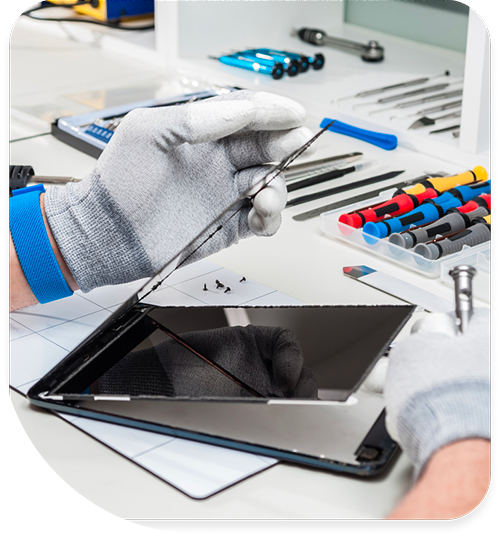
Professional Tablet Repair Services In The Fix in South County Center
The Engineering of Large-Format Displays: Tablet Repair in St. Louis, MO
How does a sheet of glass less than a millimeter thick withstand the daily torque of a commute along Lindbergh Boulevard? The answer lies in the engineering of modern tablets, which rely on the tension between the display assembly and the aluminum unibody to maintain structural rigidity. When looking for Tablet Repair in St. Louis, MO, it is helpful to understand that these devices are not just "big phones." They possess distinct architectural vulnerabilities that react specifically to the local environment of the 63129 zip code.
Unlike smartphones, which have a relatively small surface area, tablets effectively act as large sails. They capture vibrations and physical stress across a much wider plane. A backpack sitting on the floor of a car navigating the potholes of South County transfers kinetic energy directly into the tablet’s chassis. Understanding the mechanics of how these devices fail—and how they are reconstructed—reveals why professional intervention is critical for longevity.
The Physics of Chassis Flex and Glass Failure
The primary cause of screen failure in tablets is often not a direct impact, but "torsional stress" or twisting. When a tablet is placed in a bag with heavy books or groceries, the aluminum frame can bend slightly. Glass, however, has zero elasticity. It cannot bend; it can only shatter.
In St. Louis, we see a high incidence of "hairline fractures" that appear mysteriously. These are typically the result of this chassis flex. If the aluminum frame is bent even by a fraction of a millimeter, it exerts constant pressure on the glass from the side. A sudden temperature drop—common during our winters—causes the metal to contract faster than the glass, snapping the display. Correcting this requires more than just a new screen; the frame itself must be reshaped and leveled using precision tools, or the new glass will break under the same tension within weeks.
Adhesive Chemistry in High Humidity
Tablets rely heavily on chemical adhesives rather than mechanical screws to hold the screen in place. The industrial tape used by manufacturers is rated for specific humidity ranges. St. Louis, with its high summer humidity index, poses a challenge to these bonds.
Moisture in the air can slowly permeate the seam between the glass and the frame, causing a process known as "hydrolytic degradation" of the adhesive. This manifests as "screen lifting," where the glass begins to pull away from the body, usually near the corners. This gap destroys the hermetic seal of the device, allowing dust from the local environment to enter the LCD layers. Professional repair involves removing the compromised factory adhesive and applying a high-tensile, humidity-resistant bonding agent that is cured under UV light to create a seal impervious to Missouri’s atmospheric moisture.
The Digitizer vs. The LCD: A Layered Analysis
To understand tablet repair, one must distinguish between the two primary visual components. The "Digitizer" is the top layer of glass that senses your touch via capacitive grids. The "LCD" (Liquid Crystal Display) is the layer underneath that creates the image.
In many modern tablets, these two are fused together with optically clear adhesive (OCA) to reduce glare. This is known as a laminated display. Separating them requires freezing the screen to -180°C or using hot-wire separation machines. In older or budget models, they are separate. Diagnosing which layer has failed is key. If the glass is cracked but the picture is perfect, only the digitizer needs replacement (on non-laminated models). If the image has "ink bleeds" or black spots, the liquid crystals have ruptured, requiring a full assembly replacement.
Battery Surface Area and Thermal Expansion
Tablet batteries are massive, often taking up 60-70% of the internal volume. This large surface area makes them highly susceptible to thermal expansion. Leaving a tablet in a vehicle at South County Center during a hot afternoon heats this large chemical power plant.
Unlike a phone battery, which might swell slightly, a tablet battery can expand with enough force to push the screen upwards, bowing the glass from the inside out. This internal pressure creates "pressure spots" on the LCD—visible as white or yellow blobs on the screen. This is a critical safety warning. The lithium-polymer cells are under extreme stress. Piercing a swollen battery during a DIY repair attempt can lead to immediate thermal runaway. Professional removal involves dissolving the adhesive underneath the battery without bending the volatile cells.
The Charging Port Lever Effect
Due to their weight, tablets are often used while resting on a surface, plugged into a charger. This creates a leverage point at the charging port. If the device slips or is tilted, the cable acts as a lever, prying the internal soldering points off the motherboard.
This is a structural failure of the logic board, not just a broken port. The "pads" (copper contact points) are often ripped from the fiberglass substrate of the board. Repairing this requires microsoldering techniques to reconstruct the missing copper traces before a new port can be installed. It is a precise reconstruction of the electrical pathway, ensuring the device can negotiate the higher amperage required to charge these large batteries.
Technical Q&A: Tablet Engineering
Q: Why does my stylus/pencil have "dead zones" after a screen repair? A: This occurs when low-quality aftermarket digitizers are used. The stylus relies on a dense grid of copper sensors embedded in the glass. If the grid density of the replacement part is lower than the manufacturer's specification, or if the control chip on the ribbon cable is not properly shielded, the tablet cannot track the fine movements of the stylus. We use components with grid densities that match the specifications to ensure linearity and pressure sensitivity are preserved.
Q: Can a bent iPad frame be straightened without replacing it? A: In many cases, yes. We use a specialized tool called a "gPanel" or corner reshaping tool designed specifically for tablet aluminum. This tool applies controlled pressure to bend the sidewalls back into a 90-degree angle and flatten the backplate. However, if the metal is kinked or cracked (structural fatigue), the housing must be replaced to ensure the new screen has a flat surface to adhere to.
Q: Why is "ghost touching" common after a drop, even if the glass isn't broken? A: A drop can damage the digitizer cable connector or cause a microscopic tear in the ribbon cable. This sends erratic electrical signals to the touch controller, which the tablet interprets as rapid touches. It can also be caused by a tiny shard of glass (from a chipped corner) pressing into the digitizer layer from the side. This is a hardware fault that requires replacing the touch panel, as the capacitive grid has been physically compromised.
Other Locations Near By You
The Fix in Walmart St. Louis
3270 Telegraph Rd, St. Louis, MO 63125, United States
The Fix in St. Louis Galleria
1155 Galleria Pkwy #1081, St. Louis, MO 63117, United States
The Fix in Walmart Manchester
201 Highlands Blvd Dr, Manchester, MO 63011, United States
The Fix in Walmart Kansas City
8301 N Church Rd, Kansas City, MO 64158, United States
The Fix in Walmart Lee's Summit
1000 NE Sam Walton Ln, Lee's Summit, MO 64086, United States
The Fix in Walmart Lake St. Louis
6100 Ronald Reagan Dr, Lake St Louis, MO 63367, United States
The Fix in Walmart Raytown
10300 E State Rte 350, Raytown, MO 64138, United States
The Fix in Walmart Wentzville
1971 Wentzville Pkwy, Wentzville, MO 63385, United States
The Fix in Walmart Maplewood
1900 Maplewood Commons Dr, Maplewood, MO 63143, United States
The Fix in West County
80 W County Center Dr Store #2187 Des Peres Missouri 63131
Your local repair experts for every device
From iPhones to gaming laptops, The Fix in St. Louis, MO is your one-stop shop for device repair. Quick turnarounds, affordable prices, and local experts you can trust

Phone Cases
Protect your device in style! At The Fix in St. Louis, MO, we offer a wide selection of durable phone cases for all major brands—sleek designs that keep your phone safe and looking great.

Nintendo Switch Repair
Cracked Nintendo Switch screen? We repair Switch devices in St. Louis, MO quickly and affordably. Fast, easy, and always with high-quality parts.

MacBook Repair
For broken screens, battery replacements, or other issues, The Fix in St. Louis, MO provides quick MacBook repairs with premium parts.

PlayStation Repair
Is your PlayStation giving you trouble? At The Fix in St. Louis, MO, we handle PlayStation repairs with care and quality parts—no long waits, no hassle.
Google Repair
Need your Google Pixel fixed? At The Fix in St. Louis, MO, we repair cracked screens, charging issues, and more—always using high-quality parts for lasting results.

Computer Repair
Need PC or desktop service in St. Louis, MO? We provide free diagnostics and affordable repairs, always with high-quality parts.

Game Console Repair
From Nintendo Switch® to PlayStation and Xbox, The Fix in St. Louis, MO repairs all major game consoles. Fast service and dependable results.

Laptop Repair
Got a broken laptop? The Fix In St. Louis, MO, our team repairs most laptop brands and models using high-quality replacement parts.

iPad Repair
Need your iPad fixed? At The Fix in St. Louis, MO, we repair cracked screens, charging issues, and more—always using high-quality parts for lasting results.

Cell Phone Repair
We repair all major phone brands in St. Louis, MO. iPhone, Samsung, Google, and more—get your phone fixed fast.

iPhone Repair
Cracked screen? Battery draining too fast? Our team in St. Louis, MO repairs iPhones with precision and high-quality parts to make your device feel new again.

Samsung Repair
Whether it’s a Galaxy screen replacement or a charging issue, The Fix in St. Louis, MO offers fast and reliable Samsung repairs.

Xbox Repair
Xbox not working properly? Our team in St. Louis, MO offers quick, reliable Xbox repairs with free diagnostics and high-quality replacement parts.


Trusted repair solution for mobile phones, tablets, gaming consoles, and computer systems. We provide fast, reliable, and affordable repair services to get your devices back in perfect working condition.
The Fix is an independent repair service provider and is not affiliated with, sponsored by, or endorsed by Apple Inc., Samsung Electronics, Google LLC, or any other device manufacturer. We use high-quality compatible replacement parts unless explicitly stated. All trademarks are property of their respective owners.


© Copyright The Fix Solutions All rights reserved 2026.
Design by Deepcoder