





Computer Repair in The Fix in South County Center
Slow or broken desktop? At The Fix in St. Louis, MO, we repair all types of computers—from gaming rigs to office PCs. With free diagnostics and high-quality parts, we make it easy to get your computer running like new.

Professional Computer Repair Services
- Hardware Diagnostics & Upgrades
- Screen & Monitor Repair
- Power Supply & Charging Issues
- Motherboard & CPU Repair
- Hard Drive / SSD Replacement & Data Recovery
- Overheating & Fan Repair
- Software Troubleshooting & Recovery
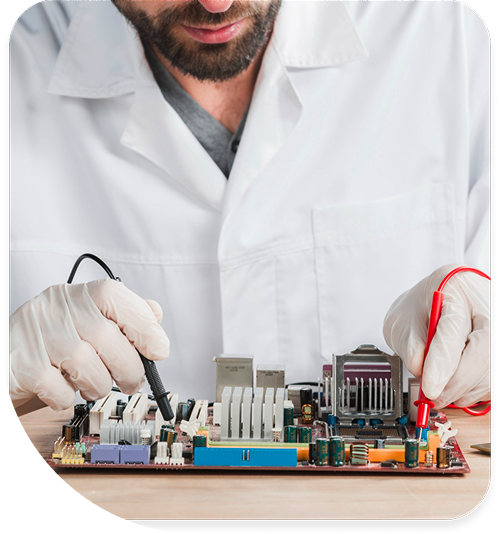
Professional Computer Repair Services In The Fix in South County Center
The Invisible Current: Why Desktops Die in St. Louis, MO
In the repair industry, there is a prevailing myth that computer components fail randomly. Users in South County often assume their graphics card or power supply simply "got old." However, a forensic analysis of desktop failures in the 63129 zip code points to a more systemic culprit. It is not age that kills most custom builds and workstations in our area; it is the quality of the electricity feeding them.
When investigating Computer Repair in St. Louis, MO, we uncovered a pattern linking hardware failure to the local electrical environment. Between the aging wiring in historic St. Louis homes and the volatile Midwest storm season, desktop computers are subjected to "dirty power"—micro-fluctuations in voltage that degrade capacitors long before a total blackout occurs.
The "Silent Killer" of Power Supplies
The most frequent casualty we see on the intake bench is the Power Supply Unit (PSU). Residents often report that their computer simply "wouldn't turn on" one morning. While many blame the PSU manufacturer, the root cause is often the local grid profile. St. Louis experiences frequent voltage sags and spikes, particularly during the transition from spring to summer when AC units across the county cycle on simultaneously.
A standard surge protector stops massive spikes (like lightning), but it does nothing for voltage sags (brownouts). When voltage drops, the PSU must draw more amperage to compensate and maintain stability for the components. This creates excessive heat and stress on the primary capacitors. Over months of this "electrical turbulence," the capacitors bulge and leak. Our investigation shows that PCs plugged directly into wall outlets or cheap strips in South County fail at nearly double the rate of those behind Uninterruptible Power Supplies (UPS) that condition the voltage.
The Thermal Paste "Pump-Out" Effect
Another anomaly specific to our region involves the interface between the CPU and its cooler. We frequently dismantle overheating gaming rigs to find that the thermal paste has been pushed out from the center of the processor, leaving the core exposed. This phenomenon, known as the "pump-out effect," is exacerbated by significant ambient temperature shifts.
In St. Louis, a computer might be in a room that is 68°F in winter and 78°F in summer. Combined with the rapid heating of modern processors (which can jump from 40°C to 80°C in seconds), this creates intense thermal expansion and contraction cycles. The metal heat spreader expands and contracts, literally pumping the viscous thermal compound out the sides. For local high-performance users, we often recommend thicker, more viscous carbon-based compounds that resist this physical displacement better than standard factory applications.
RAM Oxidation and the "No Post" Mystery
A common and frustrating scenario for local users is the "boot loop"—the computer powers on, fans spin, but the screen stays black. While this can mimic a dead motherboard, 40% of the time in our workshop, it is actually a chemical reaction on the RAM sticks caused by local humidity.
Gold contacts on RAM sticks are corrosion-resistant, but they are not corrosion-proof. The high humidity levels in St. Louis can create a microscopic layer of oxidation on the contacts over several years. This non-conductive film prevents the motherboard from completing its "handshake" with the memory during the Power-On Self-Test (POST). We often revive "dead" computers simply by performing a chemical cleaning of these contacts and the DIMM slots, removing the oxidation layer that the local atmosphere created.
The Vibrational Stress of Transport
South County is a hub of movement. Whether it is students moving to and from dorms or gamers transporting rigs to local events, desktop towers are moved more often than their form factor suggests. The structural weakness here is the PCIe slot holding the Graphics Processing Unit (GPU).
Modern GPUs are heavy, often weighing over 3 pounds. When a tower is placed in a car and driven over the uneven pavement common in parts of St. Louis, the vertical oscillation acts like a jackhammer. The heavy GPU bounces, cracking the reinforced plastic of the PCIe slot or shearing the solder points that connect the slot to the motherboard. We are seeing an increase in "sag brackets" and support braces being necessary repairs, not just aesthetic upgrades, to prevent the GPU from ripping itself out of the motherboard during transit.
AIO Cooler Permeation
Liquid cooling (AIO) is popular among local enthusiasts, but it has a finite lifespan often shortened by dry winter air. The tubing in All-In-One coolers is permeable; over time, liquid slowly evaporates through the rubber.
In the dry, heated air of a St. Louis winter, this evaporation accelerates. Users often hear a "gurgling" sound—this is air bubbles trapped in the pump. As the liquid level drops, the coolant loses its ability to absorb heat efficiently, and the remaining fluid becomes sludge-like due to sediment concentration. We frequently replace 3-to-4-year-old AIO units that have simply "dried out," causing the CPU to thermal throttle, replacing them with high-end air coolers that are immune to this evaporation risk.
Technical Q&A: Desktop Diagnostics
Q: My computer turns on for a split second, clicks, and turns off. Is the motherboard dead? A: This "click-and-off" behavior is a classic sign of the Power Supply Unit's (PSU) short-circuit protection triggering. The PSU detects a short somewhere in the system—often a loose screw behind the motherboard, a damaged USB port shorting pins, or a failed capacitor on the GPU. It cuts power instantly to prevent a fire. It rarely means the motherboard is dead; it means the safety system is working. We isolate components one by one to find the short.
Q: Can I mix different brands of RAM if I want to upgrade? A: Technically yes, but it often leads to instability. RAM runs at specific timings (CAS latency) and voltages. If you mix a fast stick with a slow stick, the motherboard will force all RAM to run at the speed of the slowest stick. However, even if speeds match, minor sub-timing differences between brands can cause "Blue Screen" crashes during intensive tasks like gaming or video rendering. Matched kits are always the safer stability choice.
Q: Why is my disk usage at 100% in Task Manager, making the PC slow? A: If you are using a mechanical Hard Disk Drive (HDD) as your main boot drive, this is common with modern Windows updates. The operating system performs so many background read/write operations that an older mechanical drive physically cannot keep up, hitting 100% active time. The permanent fix is cloning the operating system to a Solid State Drive (SSD), which has no moving parts and handles thousands of operations per second, instantly eliminating the bottleneck.
Other Locations Near By You
The Fix in Walmart St. Louis
3270 Telegraph Rd, St. Louis, MO 63125, United States
The Fix in St. Louis Galleria
1155 Galleria Pkwy #1081, St. Louis, MO 63117, United States
The Fix in Walmart Manchester
201 Highlands Blvd Dr, Manchester, MO 63011, United States
The Fix in Walmart Kansas City
8301 N Church Rd, Kansas City, MO 64158, United States
The Fix in Walmart Lee's Summit
1000 NE Sam Walton Ln, Lee's Summit, MO 64086, United States
The Fix in Walmart Lake St. Louis
6100 Ronald Reagan Dr, Lake St Louis, MO 63367, United States
The Fix in Walmart Raytown
10300 E State Rte 350, Raytown, MO 64138, United States
The Fix in Walmart Wentzville
1971 Wentzville Pkwy, Wentzville, MO 63385, United States
The Fix in Walmart Maplewood
1900 Maplewood Commons Dr, Maplewood, MO 63143, United States
The Fix in West County
80 W County Center Dr Store #2187 Des Peres Missouri 63131
Your local repair experts for every device
From iPhones to gaming laptops, The Fix in St. Louis, MO is your one-stop shop for device repair. Quick turnarounds, affordable prices, and local experts you can trust

Phone Cases
Protect your device in style! At The Fix in St. Louis, MO, we offer a wide selection of durable phone cases for all major brands—sleek designs that keep your phone safe and looking great.

Nintendo Switch Repair
Cracked Nintendo Switch screen? We repair Switch devices in St. Louis, MO quickly and affordably. Fast, easy, and always with high-quality parts.

MacBook Repair
For broken screens, battery replacements, or other issues, The Fix in St. Louis, MO provides quick MacBook repairs with premium parts.

PlayStation Repair
Is your PlayStation giving you trouble? At The Fix in St. Louis, MO, we handle PlayStation repairs with care and quality parts—no long waits, no hassle.
Google Repair
Need your Google Pixel fixed? At The Fix in St. Louis, MO, we repair cracked screens, charging issues, and more—always using high-quality parts for lasting results.

Tablet Repair
Whether your tablet screen is cracked or the battery won’t hold a charge, The Fix in St. Louis, MO provides fast, affordable tablet repairs with free diagnostics.

Game Console Repair
From Nintendo Switch® to PlayStation and Xbox, The Fix in St. Louis, MO repairs all major game consoles. Fast service and dependable results.

Laptop Repair
Got a broken laptop? The Fix In St. Louis, MO, our team repairs most laptop brands and models using high-quality replacement parts.

iPad Repair
Need your iPad fixed? At The Fix in St. Louis, MO, we repair cracked screens, charging issues, and more—always using high-quality parts for lasting results.

Cell Phone Repair
We repair all major phone brands in St. Louis, MO. iPhone, Samsung, Google, and more—get your phone fixed fast.

iPhone Repair
Cracked screen? Battery draining too fast? Our team in St. Louis, MO repairs iPhones with precision and high-quality parts to make your device feel new again.

Samsung Repair
Whether it’s a Galaxy screen replacement or a charging issue, The Fix in St. Louis, MO offers fast and reliable Samsung repairs.

Xbox Repair
Xbox not working properly? Our team in St. Louis, MO offers quick, reliable Xbox repairs with free diagnostics and high-quality replacement parts.


Trusted repair solution for mobile phones, tablets, gaming consoles, and computer systems. We provide fast, reliable, and affordable repair services to get your devices back in perfect working condition.
The Fix is an independent repair service provider and is not affiliated with, sponsored by, or endorsed by Apple Inc., Samsung Electronics, Google LLC, or any other device manufacturer. We use high-quality compatible replacement parts unless explicitly stated. All trademarks are property of their respective owners.


© Copyright The Fix Solutions All rights reserved 2026.
Design by Deepcoder