





iPad Repair in The Fix in Paramus Park
Cracked screen or battery draining too fast? At The Fix in Paramus, NJ, we provide fast and reliable iPad repairs. From screen replacements to charging issues, our technicians use high-quality parts and offer free diagnostics so you know exactly what’s needed.

Professional iPad Repair Services
- Screen Repair & Replacement
- Battery Replacement
- Water Damage Repair
- Charging Port Repair
- Camera Repair
- Speaker & Microphone Repair
- iOS Troubleshooting & Recovery
Professional iPad Repair Services In The Fix in Paramus Park
Need iPad Repair in Paramus, NJ 07652?
You're reviewing project documents during a meeting near Route 17 when your iPad's screen suddenly stops responding to touch input along the right edge, forcing you to rotate the device awkwardly to access controls. Or perhaps you notice the device no longer sits flush on your desk—a slight bulge has developed beneath the display, indicating something inside has expanded dangerously. iPads serve critical roles in professional and educational environments throughout Bergen County, functioning as portable workstations, digital notepads, and creative tools. When hardware failures compromise these functions and you need expert iPad Repair in Paramus, NJ, understanding whether you're dealing with digitizer damage, battery swelling, charging port corrosion, or logic board faults determines both repair approach and data preservation strategies.
Apple designs iPads with remarkable component integration—display assemblies fuse multiple layers with optically clear adhesive, batteries adhere with industrial-strength strips, and logic boards pack components with extraordinary density. This integration achieves thin profiles and seamless aesthetics but creates repair scenarios requiring specialized equipment and methodical disassembly techniques. At 700 Paramus Park, Paramus, NJ 07652, we approach iPad repair as precision device work, utilizing controlled heating systems, component-level diagnostics, and proper adhesive resealing to restore functionality without compromising structural integrity.
Why does the touchscreen develop dead zones or phantom touches?
Touch functionality failures manifest in two primary ways: dead zones where the screen ignores touch input, or phantom touches where the iPad registers inputs without physical contact. Both symptoms indicate digitizer damage—the transparent capacitive sensor layer that detects finger position. Understanding the digitizer's architecture explains how these failures develop and why they require specific repair approaches.
The digitizer consists of microscopic transparent conductors arranged in horizontal and vertical traces forming a grid. Your finger's capacitance creates electrical field disturbances at intersection points, which the touch controller interprets as coordinate data. Physical impact—dropping the iPad on pavement near Garden State Plaza or applying excessive pressure during transport—fractures these traces. A vertical trace break creates a dead column where no touches register along that screen region. Multiple fractures produce irregular dead zones with unpredictable boundaries.
Phantom touches occur when the digitizer develops short circuits between traces that should remain electrically isolated. This happens through several mechanisms: LCD fluid leaking from pressure damage creating conductive paths, adhesive degradation allowing moisture infiltration, or micro-fractures that partially connect adjacent traces. The touch controller receives false signals indicating touches that never occurred, causing the iPad to behave erratically—apps launching spontaneously, text inserting random characters, or interface elements activating without input.
iPad display architecture complicates repair significantly. Older non-Retina iPads featured separate digitizer glass and LCD panels with air gaps between layers. These allowed digitizer-only replacement if the LCD remained functional. Modern iPads utilize laminated displays where the digitizer, LCD, and protective glass fuse into one assembly using optically clear adhesive. Any layer damage requires complete assembly replacement—attempting separation destroys the LCD's delicate structure.
We source display assemblies matching your iPad's generation and model, ensuring compatibility with features like Apple Pencil sensitivity and True Tone color adjustment. Post-installation requires Home button transfer on models with Touch ID—this component cryptographically pairs to the logic board's Secure Enclave for biometric security. We carefully extract the Home button assembly from the damaged screen and install it in the replacement display, preserving fingerprint functionality. For Face ID models, we transfer the TrueDepth camera array, maintaining facial recognition capability.
What causes battery swelling and why is it urgent?
Battery swelling represents a critical safety issue demanding immediate attention. If your iPad no longer sits flat on surfaces, shows visible bulging beneath the display, or has screen separation from the frame, a swollen battery inside is pushing components outward. This condition results from lithium-polymer battery degradation where internal gas generation inflates the cell pouch like a balloon.
Lithium-ion chemistry degrades through normal charge cycles and calendar aging. The electrolyte—a lithium salt dissolved in organic solvents—decomposes through repeated charging, particularly under thermal stress. Decomposition products include gases that accumulate within the sealed battery pouch. As pressure builds, the flexible pouch expands, exerting force on surrounding components. In iPads, the battery sits directly beneath the display, so swelling pushes the screen outward.
The danger extends beyond cosmetic issues. Expanding batteries stress the display assembly, potentially cracking the glass from internal pressure or delaminating the digitizer from the LCD. Continued swelling may rupture the battery pouch, exposing reactive lithium compounds to air and moisture. While catastrophic thermal events remain relatively rare, swollen batteries represent fire hazards that worsen over time. The pressure also damages other internal components—flex cables, connectors, and even the logic board can suffer stress fractures from battery expansion.
Several factors accelerate swelling: exposure to heat during New Jersey summers in vehicles near Van Saun Park, using incompatible chargers delivering incorrect voltage, physical damage compromising battery integrity, or simply exceeding the battery's designed service life. Heavy users accumulating charge cycles through continuous streaming or professional applications reach failure thresholds faster than casual users.
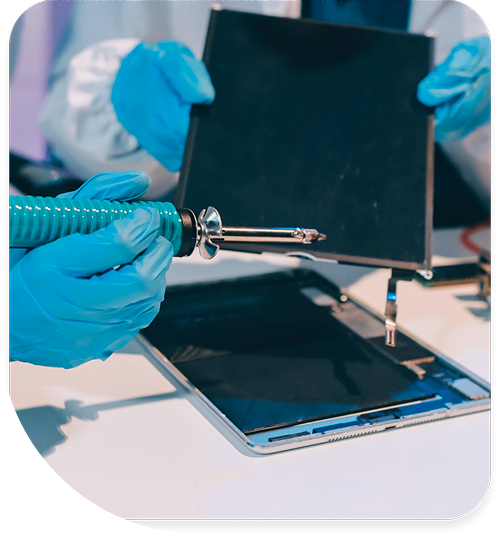
Battery replacement requires complete iPad disassembly. The display must separate from the frame using controlled heat to soften the perimeter adhesive—too little heat leaves adhesive intact, preventing separation; excessive heat damages internal components or the display itself. We use precision heating equipment maintaining exact temperature ranges. After display removal, the swollen battery presents challenges—it adheres strongly to the aluminum backing, and applying excessive force risks puncturing the inflated cell.
We use isopropyl alcohol to dissolve battery adhesive, allowing safe extraction without puncture risk. The swollen cell requires proper disposal as hazardous electronic waste—damaged lithium batteries cannot enter normal recycling streams. After removing the compromised battery and cleaning adhesive residue, we inspect the frame for pressure-induced warping. Severe swelling can permanently deform the aluminum structure, requiring frame reshaping before installing the replacement battery.
Why won't the Lightning or USB-C port charge reliably?
Charging failures present progressively: first requiring specific cable angles to initiate charging, then intermittent charging recognition where the battery icon flickers between states, finally complete charging failure despite trying multiple cables. These symptoms indicate port hardware degradation, internal debris accumulation, or flex cable damage rather than battery or charging circuit issues.
The Lightning port on older iPads contains eight pins arranged in a single row. These pins handle power delivery, USB data transfer, and accessory communication. Repeated cable insertion and removal—hundreds of cycles annually for professionals commuting via Route 4 or students at Paramus schools—gradually wears the contact surfaces. The pins lose springiness, reducing contact pressure against cable pins. Oxidation develops on pin surfaces, increasing electrical resistance until charging current cannot flow adequately.
USB-C ports on newer iPad Pros feature 24 pins in two rows with more complex functionality. The reversible design means either pin row must function correctly for charging and data transfer. Damage to pins in one row can disable specific functions—charging might work while data transfer fails, or vice versa, depending which pins suffered damage.
Debris accumulation represents another common charging failure mode. iPads carried in bags near New Bridge Medical Center or stored in pockets accumulate lint, dust, and particulate matter. This debris compresses into the port cavity over months, preventing cables from fully inserting. Reduced insertion depth means charging pins don't contact cable terminals properly, causing intermittent or absent charging.
iPad charging ports connect to the logic board via flex cables rather than direct soldering in most models. This modular design simplifies replacement—we access the port assembly after display removal, disconnect the flex cable from the logic board, and install a replacement port assembly. The flex cable typically includes the port, microphone, and cellular antenna connections (on cellular models), so replacement restores multiple functions simultaneously.
For debris-related charging issues, we perform microscope inspection identifying compacted material within the port. Non-conductive tools carefully extract lint and dust without scratching pins or damaging the port housing. Ultrasonic cleaning removes microscopic contamination, restoring proper electrical contact between pins and cables.
How does chassis bending affect functionality?
iPads' thin aluminum construction provides minimal resistance to bending forces. Sitting on the device, placing it in backpacks with heavy objects near Garden State Parkway commutes, or applying pressure to one corner during handling can permanently deform the chassis. This bending creates multiple cascading failures beyond just cosmetic appearance.
The most immediate impact affects the display. Installing a flat glass screen into a bent frame creates uneven stress distribution. The glass experiences constant tension from the warped frame trying to return to its deformed shape. This stress concentrates at mounting points, eventually fracturing the glass even without additional impact. Users experiencing repeated screen failures after repairs often have underlying frame damage causing each replacement screen to crack prematurely.
Bent frames also misalign internal components. The logic board mounts to the chassis at specific points—frame deformation shifts these mounting positions, stressing solder joints and flex cable connections. We've diagnosed mysterious boot failures and component malfunctions that traced to frame bending creating mechanical stress on logic board connections. The battery mounting area distorts, preventing proper battery seating and potentially causing internal short circuits if battery edges contact frame irregularities.
We assess frame integrity using precision straightedge tools and measurement equipment. Deviation beyond acceptable tolerances requires frame straightening before any other repairs. We use specialized fixtures applying controlled pressure to bend the aluminum back toward its designed geometry. This process requires care—excessive force can crack the brittle aluminum or damage internal mounting points. For severe damage where straightening cannot restore proper geometry, frame replacement becomes necessary, involving complete component transfer to a new housing.
What happens when Home button or Face ID sensors fail?
Biometric security systems—Touch ID Home buttons or Face ID camera arrays—provide convenient device unlocking and app authentication. When these systems fail, users lose this convenience and must rely on passcode entry exclusively. The failure mechanisms differ between Touch ID and Face ID, but both present repair challenges due to cryptographic pairing with the logic board's Secure Enclave.
Touch ID Home buttons contain a capacitive fingerprint sensor beneath a sapphire crystal surface. The sensor captures fingerprint ridge patterns, which the Secure Enclave compares against stored templates. Physical damage to the Home button—cracks in the sapphire, cable damage from drop impacts, or water infiltration corroding the sensor—disables fingerprint recognition. Importantly, each Touch ID sensor pairs uniquely to its logic board during manufacturing. Installing a different Home button, even from an identical iPad model, results in non-functional Touch ID. The button clicks mechanically but fingerprint scanning remains disabled.
We preserve Touch ID during screen repairs by carefully transferring the Home button assembly from the damaged display to the replacement screen. This requires meticulous work removing the button without tearing its delicate flex cable. The button adhesive must soften through controlled heat, and the cable routes through narrow channels requiring precise alignment during installation. Successfully transferred buttons retain full Touch ID functionality.
Face ID systems on iPad Pro models use structured light projection and infrared cameras to map facial geometry. The TrueDepth camera array includes a dot projector, flood illuminator, and infrared camera working together. This array also pairs to the logic board—replacing damaged components disables Face ID permanently. During display replacements, we transfer the entire TrueDepth module from the damaged screen to the replacement, maintaining Face ID capability.
Physical damage to Face ID sensors—cracked dot projector optics or flood illuminator damage—cannot be repaired while preserving Face ID functionality. The paired components make individual sensor replacement impossible without specialized Apple proprietary equipment. In these cases, we inform users that mechanical repairs restore all functionality except Face ID, which requires passcode authentication instead.
Why choose local service for iPad repairs?
Professional and educational workflows depend on iPad availability. Sending devices to distant repair centers means multi-week turnarounds during which critical tools remain inaccessible. Our Paramus Park location provides same-day diagnostics—bring your iPad during morning hours, and we identify the specific issue before day's end. Common repairs like battery replacement or charging port service complete within 24-48 hours. Complex repairs requiring logic board work or frame straightening may take 3-5 days, but you receive progress updates throughout.
Direct communication with repair technicians offers practical advantages. You discuss symptoms in detail, helping us understand usage patterns that might contribute to failures. We explain technical findings in accessible terms—why your battery swelled, how digitizer damage occurred, or what caused charging failures. This transparency helps you understand not just the repair but also how to prevent recurrence through proper device handling and maintenance.
Geographic convenience matters for busy professionals near Route 17 offices or students balancing class schedules. Drop off your iPad between appointments, continue your day, and return when repair completes. No shipping hassles, no extended waiting periods without your device, and no wondering about repair status in distant facilities.
Restoring iPad Functionality Through Precise Repair
iPad hardware failures affect productivity, creativity, and communication for users throughout Ridgewood and Bergen County. Touchscreen issues, battery swelling, charging problems, or biometric failures represent specific component faults with proven repair solutions. Stop by 700 Paramus Park, Paramus, NJ 07652, where we'll diagnose your iPad's exact issue through systematic component testing and explain repair options with complete technical transparency.
Frequently Asked Questions
Q: Will my data remain intact during an iPad screen replacement in Paramus, NJ?
A: Screen replacement involves no interaction with storage or data systems. We disconnect the battery, remove the damaged display, and install the replacement without accessing memory or files. Your photos, documents, and settings remain completely untouched. However, we always recommend iCloud backup before any repair as a precautionary measure against unexpected complications.
Q: My iPad has a small crack in the corner—can I keep using it near Garden State Plaza?
A: While the iPad may function currently, corner cracks propagate under normal handling stress. The crack will spread across the screen over days or weeks. More critically, cracks allow moisture infiltration that corrodes internal components. Continued use risks LCD damage, digitizer failure, or even logic board corrosion from moisture exposure. We recommend repair before crack progression causes additional damage requiring more extensive component replacement.
Q: Can you replace just the glass if the screen displays correctly but won't respond to touch?
A: Touch functionality depends on the digitizer layer, not the glass surface. Since iPads use laminated displays fusing glass, digitizer, and LCD into one assembly, separating layers destroys the LCD structure. Complete display assembly replacement becomes necessary even when only touch functionality failed. This ensures proper layer bonding and prevents dust infiltration that occurs when attempting layer separation.
Other Locations Near By You
The Fix in American Dream in East Rutherford
1 American Dream Wy, East Rutherford, NJ 07073
The Fix in Bridgewater Commons
400 Commons Way, Bridgewater Township, NJ 08807, United States
The Fix in The Mills at Jersey Gardens
651 Kapkowski Rd Elizabeth, NJ 07201
The Fix in Walmart Vineland
1070 W Landis Ave, Vineland, NJ 08360, United States
The Fix in Walmart Riverdale
48 NJ-23, Riverdale, NJ 07457
The Fix Kiosk in Bridgewater Commons
400 Commons Way Suite 7504, Bridgewater, NJ 08807, USA
The Fix in Deptford Mall
1750 Depford Center Road, Deptford, NJ
The Fix in Hoboken
131 Washington St, Hoboken NJ 07030
Your local repair experts for every device
From iPhones to gaming laptops, The Fix in Paramus, NJ is your one-stop shop for device repair. Quick turnarounds, affordable prices, and local experts you can trust

Phone Cases
Protect your device in style! At The Fix in Paramus, NJ, we offer a wide selection of durable phone cases for all major brands—sleek designs that keep your phone safe and looking great.

Nintendo Switch Repair
Cracked Nintendo Switch screen? We repair Switch devices in Paramus, NJ quickly and affordably. Fast, easy, and always with high-quality parts.

MacBook Repair
For broken screens, battery replacements, or other issues, The Fix in Paramus, NJ provides quick MacBook repairs with premium parts.

PlayStation Repair
Is your PlayStation giving you trouble? At The Fix in Paramus, NJ, we handle PlayStation repairs with care and quality parts—no long waits, no hassle.

Google Repair
Need your Google Pixel fixed? At The Fix in Paramus, NJ, we repair cracked screens, charging issues, and more—always using high-quality parts for lasting results.

Tablet Repair
Whether your tablet screen is cracked or the battery won’t hold a charge, The Fix in Paramus, NJ provides fast, affordable tablet repairs with free diagnostics.

Computer Repair
Need PC or desktop service in Paramus, NJ? We provide free diagnostics and affordable repairs, always with high-quality parts.

Game Console Repair
From Nintendo Switch® to PlayStation and Xbox, The Fix in Paramus, NJ repairs all major game consoles. Fast service and dependable results.

Laptop Repair
Got a broken laptop? The Fix In Paramus, NJ, our team repairs most laptop brands and models using high-quality replacement parts.

Cell Phone Repair
We repair all major phone brands in Paramus, NJ. iPhone, Samsung, Google, and more—get your phone fixed fast.

iPhone Repair
Cracked screen? Battery draining too fast? Our team in Paramus, NJ repairs iPhones with precision and high-quality parts to make your device feel new again.

Samsung Repair
Whether it’s a Galaxy screen replacement or a charging issue, The Fix in Paramus, NJ offers fast and reliable Samsung repairs.

Xbox Repair
Xbox not working properly? Our team in Paramus, NJ offers quick, reliable Xbox repairs with free diagnostics and high-quality replacement parts.


Trusted repair solution for mobile phones, tablets, gaming consoles, and computer systems. We provide fast, reliable, and affordable repair services to get your devices back in perfect working condition.
The Fix is an independent repair service provider and is not affiliated with, sponsored by, or endorsed by Apple Inc., Samsung Electronics, Google LLC, or any other device manufacturer. We use high-quality compatible replacement parts unless explicitly stated. All trademarks are property of their respective owners.


© Copyright The Fix Solutions All rights reserved 2026.
Design by Deepcoder