


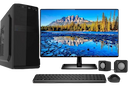


Computer Repair in The Fix in Walmart Grand Junction
Slow or broken desktop? At The Fix in Grand Junction, CO, we repair all types of computers—from gaming rigs to office PCs. With free diagnostics and high-quality parts, we make it easy to get your computer running like new.

Professional Computer Repair Services
- Hardware Diagnostics & Upgrades
- Screen & Monitor Repair
- Power Supply & Charging Issues
- Motherboard & CPU Repair
- Hard Drive / SSD Replacement & Data Recovery
- Overheating & Fan Repair
- Software Troubleshooting & Recovery

Professional Computer Repair Services In The Fix in Walmart Grand Junction
Computer Repair in Grand Junction, CO: What Grand Valley Desert Dust and Summer Flash Floods Do to Desktop Hardware on the Western Slope
Desktop computers in Grand Junction's high-desert environment face an internal contamination pattern that is specifically shaped by the Grand Valley's landscape. The region's mineral dust — a combination of sandstone fines from the Colorado National Monument canyon terrain, pale alkaline silt from the agricultural fields between Grand Junction and Palisade along the US-6 corridor, and the calcium-rich dust from the Grand Valley's calcareous soils — settles inside desktop cases through intake grilles and chassis gaps continuously. Unlike the biological particulate of Missouri's river basin or the adhesive pollen of North Texas, Grand Valley mineral dust is a dry, inert-seeming powder — but its alkaline character makes it mildly corrosive to metal contacts over time, and its fine particle size allows it to pass through desktop intake mesh and reach bearing surfaces inside the fan assembly. Fan bearing scoring from Grand Valley mineral dust is a failure mode that is specific to this high-desert market and has no equivalent in the other locations in this series.
The Fix at 2545 Rimrock Ave handles desktop computer repair including thermal paste service, SSD and hard drive assessment, RAM diagnostics, power supply evaluation, virus removal, and data recovery. The shop serves Grand Junction's households, Colorado Mesa University students, Piceance Basin energy workers, and Western Slope businesses. For computer repair in Grand Junction, CO, The Fix is in the Walmart at 2545 Rimrock Ave.
Fan Bearing Abrasion and Thermal Paste in High-Desert Dust
The fan bearings inside desktop processors and case fans are precision components that rely on smooth lubricant film between the rotating and stationary surfaces. Fine mineral dust that reaches the bearing — either through the bearing seal or by accumulating on the fan shaft at the seal interface — disrupts this lubricant film and produces the micro-abrasion that increases bearing friction, raises bearing temperature, and eventually causes the bearing noise and reduced airflow that a scored bearing produces. Grand Valley mineral dust is fine enough to penetrate bearing seals that would exclude larger particles, and its hardness — sandstone particles are primarily quartz, one of the hardest common minerals — produces bearing scoring at low concentrations. A desktop computer in a Grand Junction home where windows are open during spring and fall accumulates enough of this mineral particulate at the fan bearing interface over two to three years to produce the bearing-abrasion noise and airflow reduction that thermal overheating follows.
RAM contact corrosion in Grand Junction desktops traces to the alkaline mineral dust that settles on the gold contact fingers of RAM modules. At low humidity — the Grand Valley frequently reaches 15 to 20 percent relative humidity during downslope events from the Book Cliffs — the alkaline dust on RAM contacts acts as a mild dry etchant, and the alkaline chemistry combined with any trace moisture during humidity fluctuations produces the contact corrosion that generates intermittent memory errors. The pattern is less aggressive than the road salt corrosion of northern markets or the summer humidity oxidation of southern markets, but it is persistent and cumulative in a desktop that has gone through multiple Grand Valley open-window seasons without interior cleaning.
Flash Flood Season and Power Quality in the Grand Valley
Grand Junction's summer flash flood season — July through September — produces the brief but intense thunderstorm events that send water through the dry canyon washes around the city. These storms carry lightning that affects the Grand Valley's power grid at a rate that is lower than DFW or Missouri storm seasons in frequency but comparable in peak intensity: a nearby lightning strike on the Rimrock Ave corridor or US-6 produces a surge event that stresses desktop power supply capacitors at the same rate as any other market's lightning events. Power supplies that have absorbed multiple Grand Valley flash flood season storm events over two or three summers develop the voltage regulation degradation — system instability, random reboots, USB device dropouts — that storm-season surge accumulation produces universally.
Evaporative cooler mineral deposit also affects desktop computers in Grand Junction homes that use swamp coolers as their primary summer cooling. The trace calcium and magnesium mist from evaporative cooler operation settles on all horizontal surfaces inside the cooled rooms, including desktop intake grilles and the exposed circuit board surfaces inside desktop cases that draw cooled air from the room. Over a summer of swamp cooler operation, this mineral deposit builds up on motherboard circuit traces and RAM module contacts in the same way that road salt and river basin humidity build contamination in other markets — slowly raising the corrosion rate on metal contacts and adding a mild dielectric deposit to circuit board surfaces.
Hard drive reliability in Grand Junction desktops has a dust-driven component that is specific to this market: the drive's external controller board, which is exposed to the case interior environment, accumulates the alkaline mineral dust of the Grand Valley over open-window seasons. At low humidity, the alkaline dust on the controller board's solder joints and trace pathways acts as a dry etchant that the same dust would not produce in a humid environment — the humidity that usually neutralizes alkaline dust's corrosive character is absent in Grand Junction's high desert. The result is slow but progressive trace corrosion on controller board components that produces intermittent data access errors before outright drive failure.
Computer Diagnostics at The Fix on Rimrock Ave
The Fix runs a diagnostic sequence that accounts for Grand Junction's high-desert contamination pattern: fan bearing inspection for mineral dust abrasion alongside the standard dust accumulation check, RAM testing across multiple passes for alkaline mineral corrosion contact errors, power supply voltage measurement for flash flood season surge accumulation, and drive health evaluation using the drive's internal error log alongside controller board inspection for Grand Valley mineral dust trace corrosion. The sequence identifies the specific failure source before any hardware is replaced.
Data recovery for drives affected by controller board mineral corrosion assesses the corrosion pattern and determines whether the failure is at the board level — potentially addressable — or deeper in the drive mechanism. The Fix at 2545 Rimrock Ave handles the full desktop computer repair range on the Western Slope. Search computer repair in Grand Junction for current service availability.
Frequently Asked Questions
My desktop fan makes a grinding noise that started during a season when I had the windows open a lot. Could the Grand Valley dust have done that?
Yes. Grand Valley mineral dust — which is primarily fine quartz-rich sandstone particulate — is hard enough to score fan bearing surfaces when it reaches the bearing interface through the bearing seal. The grinding sound is the bearing running with a damaged lubricant film surface, and the noise indicates both reduced airflow efficiency and accelerated bearing progression toward failure. Fan replacement at this stage prevents the overheating that a failed bearing eventually produces; bearing replacement alone is not practical for most desktop fans, which are replaced as complete units.
My computer crashes randomly after a summer of heavy swamp cooler use. Could the cooler be affecting it?
Evaporative coolers introduce mineral-rich water vapor into room air — the dissolved calcium and magnesium in the cooler's water pad deposits as fine mineral residue on surfaces in the cooled space over a summer of operation. Inside the desktop case, this mineral deposit builds up on RAM module contacts, motherboard circuit traces, and the hard drive controller board. At Grand Junction's low humidity, the alkaline mineral deposit can act as a mild dry etchant on metal contacts, producing the intermittent RAM and storage errors that appear as random crashes. Cleaning the computer interior after swamp cooler season and testing RAM contacts addresses this.
My hard drive passes self-tests but shows occasional file access errors. I'm near the Rimrock Ave corridor. Could the environment be a factor?
The hard drive's internal self-test assesses mechanical function — it doesn't reveal trace corrosion on the external controller board's circuit traces and solder joints. Grand Valley alkaline mineral dust on the controller board produces slow trace corrosion that causes intermittent data access errors without affecting the mechanical drive functions that self-tests measure. Reading the full SMART data log reveals error counts that indicate this pattern; a controller board inspection confirms whether corrosion is present. This is a Grand Junction-specific failure mode that the standard self-test cannot detect.
Other Locations Near By You
The Fix in Walmart Lakewood
7455 W Colfax Ave, Lakewood, CO 80214, United States
The Fix in Walmart Colorado Springs
8250 Razorback Rd, Colorado Springs, CO 80920, United States
The Fix in Walmart Fountain
6310 S U.S. Hwy 85 87, Fountain, CO 80817, United States
The Fix in Walmart Aurora
3301 Tower Rd, Aurora, CO 80011, United States
Your local repair experts for every device
From iPhones to gaming laptops, The Fix in Grand Junction, CO is your one-stop shop for device repair. Quick turnarounds, affordable prices, and local experts you can trust

Phone Cases
Protect your device in style! At The Fix in Grand Junction, CO, we offer a wide selection of durable phone cases for all major brands—sleek designs that keep your phone safe and looking great.

Nintendo Switch Repair
Cracked Nintendo Switch screen? We repair Switch devices in Grand Junction, CO quickly and affordably. Fast, easy, and always with high-quality parts.

MacBook Repair
For broken screens, battery replacements, or other issues, The Fix in Grand Junction, CO provides quick MacBook repairs with premium parts.

PlayStation Repair
Is your PlayStation giving you trouble? At The Fix in Grand Junction, CO, we handle PlayStation repairs with care and quality parts—no long waits, no hassle.
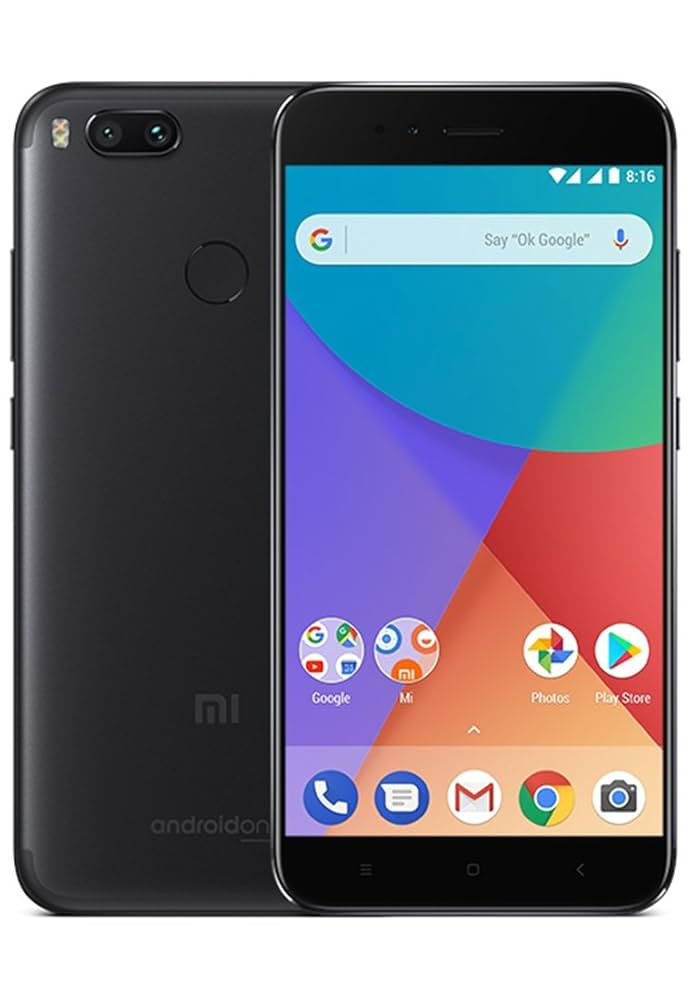
Google Repair
Need your Google Pixel fixed? At The Fix in Grand Junction, CO, we repair cracked screens, charging issues, and more—always using high-quality parts for lasting results.

Tablet Repair
Whether your tablet screen is cracked or the battery won’t hold a charge, The Fix in Grand Junction, CO provides fast, affordable tablet repairs with free diagnostics.

Game Console Repair
From Nintendo Switch® to PlayStation and Xbox, The Fix in Grand Junction, CO repairs all major game consoles. Fast service and dependable results.

Laptop Repair
Got a broken laptop? The Fix In Grand Junction, CO, our team repairs most laptop brands and models using high-quality replacement parts.

iPad Repair
Need your iPad fixed? At The Fix in Grand Junction, CO, we repair cracked screens, charging issues, and more—always using high-quality parts for lasting results.

Cell Phone Repair
We repair all major phone brands in Grand Junction, CO. iPhone, Samsung, Google, and more—get your phone fixed fast.

iPhone Repair
Cracked screen? Battery draining too fast? Our team in Grand Junction, CO repairs iPhones with precision and high-quality parts to make your device feel new again.

Samsung Repair
Whether it’s a Galaxy screen replacement or a charging issue, The Fix in Grand Junction, CO offers fast and reliable Samsung repairs.

Xbox Repair
Xbox not working properly? Our team in Grand Junction, CO offers quick, reliable Xbox repairs with free diagnostics and high-quality replacement parts.


Trusted repair solution for mobile phones, tablets, gaming consoles, and computer systems. We provide fast, reliable, and affordable repair services to get your devices back in perfect working condition.
The Fix is an independent repair service provider and is not affiliated with, sponsored by, or endorsed by Apple Inc., Samsung Electronics, Google LLC, or any other device manufacturer. We use high-quality compatible replacement parts unless explicitly stated. All trademarks are property of their respective owners.


© Copyright The Fix Solutions All rights reserved 2026.
Design by Deepcoder