





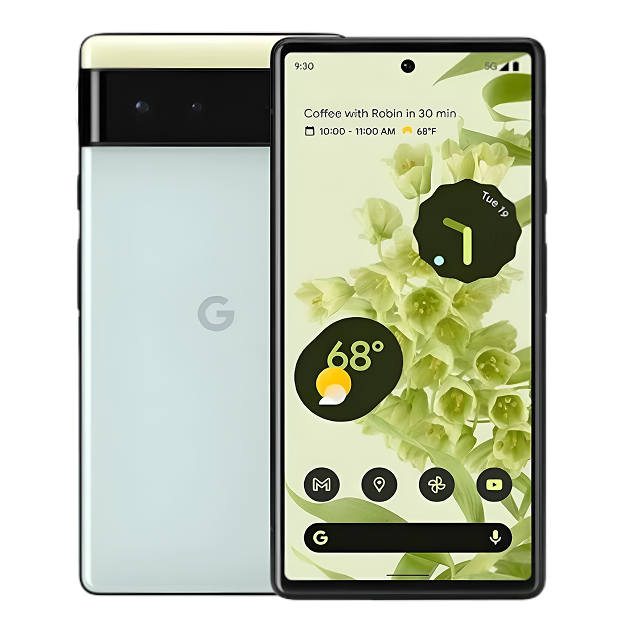
Google Pixel 6 Repair Services
Get fast, reliable, and professional Google Pixel 6 repair services at The Fix — your trusted destination for expert device care.
Common Repairs We Handle Daily


Fix Your Pixel 6 Fast: Complete Repair Roadmap
Picture this: your Pixel 6 was working perfectly until one day it just... wasn't. Battery started dying before dinner, screen developed quirks, charging became unreliable, or the phone started overheating during normal tasks. You're probably wondering whether these are fixable issues or if it's time to upgrade. Here's the deal—most Pixel 6 problems are completely repairable, and understanding what's happening helps you make the right decision.
In this guide, we'll walk you through what goes wrong with the Pixel 6, why these specific issues develop, and how professional Google Pixel 6 repair addresses each problem. Let's get your device fixed right.
What Makes the Pixel 6 Tick
Google launched the Pixel 6 in October 2021 with their first custom Tensor chip, marking a major shift in their phone strategy. You got the Tensor G1 processor with Google's AI capabilities, a 6.4-inch 90Hz OLED display, dual camera system with excellent computational photography, 4,614mAh battery, and design that stood out from typical smartphones. This was Google's statement that they could compete with Apple and Samsung using their own silicon.
We're now over three years into the Pixel 6's lifecycle, which means we've got extensive real-world data on aging patterns. That Tensor G1 chip has known thermal characteristics that affect long-term reliability. Batteries have been through 1,000+ charge cycles for many users. Displays are showing three-year aging patterns. This real-world experience helps us diagnose issues accurately.
Why No Phone Lasts Forever
Let's talk about something that's especially relevant for a three-year-old device—every component inside your Pixel 6 has been degrading since day one, and after this much time, that degradation becomes really noticeable. This isn't Google's fault or poor quality. It's fundamental physics affecting all electronics, just more visible after three years than after one.
Think about a car you've driven for three years and 50,000 miles. When new, everything was tight, quiet, smooth. After three years of daily driving, you notice things: the engine sounds different, suspension feels looser, interior materials have worn, seals have compressed, and minor issues have developed. You haven't abused it—you've just driven it normally for years, and mechanical systems accumulate wear.
Your Pixel 6 is similar. That 4,614mAh battery has been through 1,000-1,200 charge cycles for heavy users over three years. Every cycle causes permanent electrochemical changes. After this many cycles, battery capacity typically drops to 75-82% of original. That's not a defect—it's well-documented lithium-ion aging. Your battery now holds 3,460-3,780mAh instead of 4,614mAh—a loss of 834-1,154mAh.
The 6.4-inch OLED display has shown billions of images over three years. OLED organic compounds degrade with use. After this long, burn-in on status bar and keyboard is nearly universal. This is characteristic OLED aging, not poor manufacturing.
The Tensor G1 chip is Google's first-generation custom silicon, and it runs warm. Three years of thermal cycling (heating up during use, cooling down during idle) stresses solder joints and internal connections. Thermal stress accumulates over thousands of cycles.
The USB-C port has experienced 1,500+ cable insertions. Pins wear, solder joints stress, contamination accumulates. After this much use, port issues are common.
After three years, your Pixel 6 has run substantially heavier software than it shipped with. Android 12 was optimized for the hardware. You've received Android 13, 14, and now 15. Apps have updated hundreds of times. You're running much heavier software on aging hardware.
Understanding these patterns helps evaluate whether your three-year-old Pixel 6 needs repair or if you're seeing normal end-of-lifecycle aging.
Battery Degradation After Three Years
What you're experiencing: Battery life is terrible. You're lucky to make it to lunch on a full charge. Battery percentage drops rapidly and unpredictably. Charging takes forever. Phone gets hot during charging or normal use.
Why this happens: After three years of daily charging, your battery has been through 1,000-1,200+ cycles. Testing consistently shows battery health at 75-82% on devices this age. You've lost 18-25% of original capacity—that's 834-1,154mAh gone. Your battery now holds roughly the capacity of a much smaller phone.
That capacity loss is devastating for usability. The Tensor G1 is relatively power-hungry, and the 90Hz OLED consumes substantial power. With 800-1,000mAh less capacity, battery life becomes genuinely problematic.
Battery percentage jumping erratically is common on heavily degraded batteries. The management system can't accurately estimate remaining charge when cells have degraded this much. The system guesses, and those guesses are often wrong.
From our experience fixing thousands of these: Pixel 6 battery complaints after three years consistently show testing results around 75-82% health. This is normal aging for devices this age, but the degradation is severe enough that replacement makes sense for almost anyone wanting to keep the device. Battery replacement restores full capacity and transforms usability.
When repair makes sense: At three years and 75-82% health, battery replacement makes sense if you're keeping the device. Fresh battery brings it back to life. If you're considering upgrading soon anyway, battery replacement might not be worthwhile.
Display Aging on Three-Year-Old OLEDs
What you're experiencing: Obvious burn-in on status bar and keyboard. Green tint at low brightness. Brightness variance across the screen. Maybe even pink tint in certain areas. Image retention where content temporarily ghosts.
Why this happens: After three years of heavy use, OLED degradation is significant and visible. Burn-in after this long is nearly universal—it's not "if" but "how bad." Status bar and keyboard burn-in are extremely common because those elements remain static for hours daily over three years.
The tint becoming more noticeable relates to uneven organic compound degradation. OLEDs don't age uniformly—different colors degrade at different rates, causing tint that wasn't visible when new to become apparent.
What actually happens with most units: Almost all three-year-old Pixel 6 displays show visible burn-in. This is normal aging, not defective. The question is whether it's severe enough to warrant expensive screen replacement on a three-year-old device.
When repair makes sense: Severe burn-in that genuinely impacts usability might justify screen replacement if you're keeping the device long-term. Moderate burn-in that's annoying but not debilitating probably doesn't justify expensive repair on a device this age.
Thermal Issues with Tensor G1
What you're experiencing: Phone gets noticeably hot during normal tasks. Performance throttles more aggressively than it used to. Battery drains faster when phone is warm. Phone sometimes feels warm even when idle.
Why this happens: The Tensor G1 has known thermal characteristics—it runs warmer than competitors' chips. After three years of thermal cycling, thermal interface materials degrade, making heat dissipation less efficient. The phone gets warmer than it used to for the same tasks.
Degraded battery also contributes. As batteries age and internal resistance increases, they generate more heat during charging and discharge. Combined with Tensor G1 heat, thermal management becomes more aggressive, throttling performance more than when new.
The reality from our repair experience: Thermal issues on three-year-old Pixel 6 devices often improve with battery replacement because the degraded battery was generating excessive heat. However, Tensor G1's thermal characteristics are inherent—replacing battery helps but doesn't eliminate warmth during intensive tasks.
When repair makes sense: If thermal issues stem primarily from degraded battery generating heat, battery replacement helps significantly. If issues persist after battery replacement, they're inherent Tensor G1 characteristics that repair can't fully address.
Charging Port Problems After Extensive Use
What you're experiencing: Charging is completely unreliable. Cable doesn't stay connected. Connection drops constantly. Fast charging doesn't work. Or port seems completely dead.
Why this happens: After three years and 1,500+ insertions, port issues are extremely common. Severe contamination is nearly universal. Mechanical wear is significant. Pins bend or wear. Solder joints crack.
What we've seen in our repair shop: On three-year-old Pixel 6 devices, about 50% have severe contamination, 30% have actual hardware failure, and 20% have both. Professional cleaning solves contamination issues. Hardware failure requires port replacement.
When repair makes sense: Port replacement on a three-year-old device makes sense if you're keeping it another year+. If you're upgrading soon, port repair might not be worthwhile.
What to Expect at The Fix
Free diagnostic: We test battery capacity (typically 75-82% on three-year-old devices), display condition, charging port, and overall functionality.
Honest assessment: We'll tell you whether repair makes sense for a three-year-old device. Sometimes maintenance (cleaning, software optimization) is enough. Sometimes battery replacement transforms usability. Sometimes the device is genuinely end-of-life and repair isn't worthwhile.
Repair options: Battery replacement, charging port service, screen replacement—we explain what each costs and whether it makes sense for your situation.
Quality work: If you decide to repair, we maintain water-resistant sealing and use quality components.
Same-day service: Most common repairs finish same-day.
Fix Your Pixel 6 Fast: Complete Repair Roadmap
Your Pixel 6 is three years old—substantial age for constant-use electronics. Battery degradation is severe at this age. Display aging is visible. Port wear is common. Software is much heavier than at launch.
Whether repair makes sense depends on your situation. Keeping the device another year+? Battery replacement transforms usability. Upgrading in 6 months? Repair might not be worthwhile. Bring your Pixel 6 to The Fix for honest assessment. We'll test everything, explain what we find, and give you straightforward advice about whether Google Pixel 6 repair makes sense for your specific situation. No pressure—just honest expertise.


Trusted repair solution for mobile phones, tablets, gaming consoles, and computer systems. We provide fast, reliable, and affordable repair services to get your devices back in perfect working condition.
The Fix is an independent repair service provider and is not affiliated with, sponsored by, or endorsed by Apple Inc., Samsung Electronics, Google LLC, or any other device manufacturer. We use high-quality compatible replacement parts unless explicitly stated. All trademarks are property of their respective owners.


© Copyright The Fix Solutions All rights reserved 2026.
Design by Deepcoder